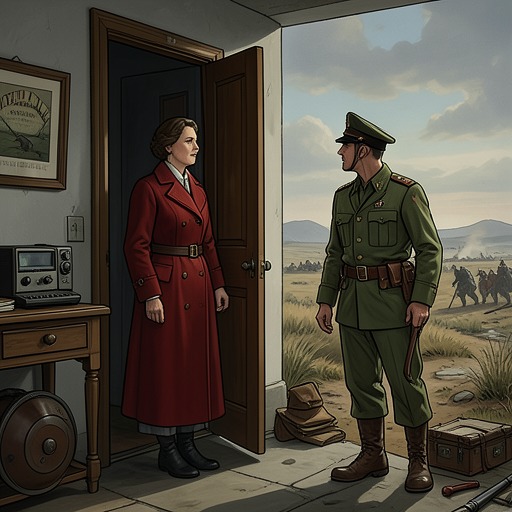
Marie-Laure escapes into the cellar after the bombing
All the Light We Cannot SeeAfter the bombers have passed over Saint-Malo, Marie-Laure leaves the shelter of her bed and descends through her damaged home toward the cellar. The retreat is made under continuing artillery fire, through smoke, broken household objects, and a building she can navigate by touch and remembered detail. She keeps the miniature house containing the Sea of Flames close, takes what food she can find, and shuts herself underground as another shell approaches. The scene turns the familiar house into a perilous route: each landing offers both a remembered feature and a new sign of destruction.
The Bombardment and the Decision to Move
The passage begins in the interval after the bombers’ roar has hardly faded. An artillery shell whistles over the house and explodes nearby; fragments or cinders patter onto the roof. Marie-Laure is beneath the bed, but she recognizes that remaining high in the house is dangerous and forces herself out. The decision is practical and immediate: she must leave the upper floor and get lower, though the route itself remains exposed to further explosions.
Before going, she returns the Sea of Flames to the miniature house. She restores its wooden roof panels, twists the chimney back into place, and slips the model into her dress pocket. This is not an incidental possession she abandons in the scramble. Even as the house is being damaged and her movement is urgent, she protects the small structure that conceals the stone and carries it with her. Her escape therefore begins with two connected tasks: reaching shelter and preserving the object entrusted to her.
A Descent Measured by Touch and Memory
Marie-Laure searches the floor for her shoes, but her fingers find only bits of wood and what may be shards of glass. She takes her cane and goes into the hall in her stocking feet. Smoke smells stronger beyond the room, while the floor and walls still feel cool. On the sixth floor, she uses the toilet, then suppresses the instinct to flush because she knows the water will not refill. Before continuing, she checks the air again, making sure it does not feel warm. In a damaged house, ordinary habits have become decisions about scarce water and signs of danger.
She counts six paces to the stairwell. When another shell screeches overhead, she shrieks; the chandelier above her chimes as the explosion lands deeper in the city. The stairs give her a more dependable map than sight could provide: eight curving steps to the bottom, with the second and fifth steps creaking, then eight more around the newel. She works downward from the fourth floor to the third, tracking her position through remembered counts and sounds rather than a visual overview of the house.
At the third-floor landing, she checks the trip wire Etienne LeBlanc built beneath the telephone table. Its bell remains suspended, and the wire still runs taut through the hole drilled in the wall. No one has come or gone. The detail briefly makes the house legible as a place that can still be monitored, even while shells and falling debris unsettle it. Her descent is not a blind rush: she pauses to verify what the house’s improvised alarm can tell her before moving on.
What She Takes, and What the House Has Lost
In the third-floor bathroom, Marie-Laure finds the bathtub full. Plaster flakes or other debris float on the surface, and grit lies beneath her knees, but she drinks as much as she can. She then returns to the stairwell and continues down. On the first floor, the carved grapevines on the banister mark a familiar point; the coatrack has fallen, and sharp fragments in the hall seem to be crockery from the dining-room hutch. She steps as lightly as she can around them.
The lower floor bears clearer signs of damage. She smells more smoke, and some windows must have blown out. Etienne LeBlanc’s wool coat still hangs in the foyer, so she puts it on, although her shoes remain missing. In the kitchen, fallen shelves and pots have turned the room into a jumble; a cookbook lies facedown in her path, and she finds a half-loaf left from the previous day in a cupboard. The coat and bread become practical equipment for the descent, gathered from rooms whose familiar order has broken apart.
The Cellar as Shelter
At the center of the floor is the cellar door with its metal ring. Marie-Laure slides aside the small dining table and heaves open the hatch. The cellar promises protection, but approaching it means confronting a different atmosphere from the smoke above: damp, mice, and the stink of stranded shellfish. Its smell suggests water that once swept through and drained away only slowly. At the open doorway, she hesitates between the fires outside and the clammy odor rising from below.
She recalls Etienne LeBlanc’s explanation of smoke as suspended particles, billions of drifting carbon molecules: bits of living rooms, cafés, trees, and people. The scientific description gives the haze a material meaning, but the list also makes the destruction intimate. Smoke is not simply a sign of danger; it consists of remnants of places and lives. A third shell screams toward the city from the east. Marie-Laure feels for the miniature house in her pocket, takes the bread and her cane, climbs down the ladder, and pulls the trapdoor shut. The episode ends not with safety confirmed, but with her having crossed from the damaged rooms into the cellar, carrying the stone’s hiding place and the necessities she could salvage.